
Your Network Data Is Degrading Faster Than You Think
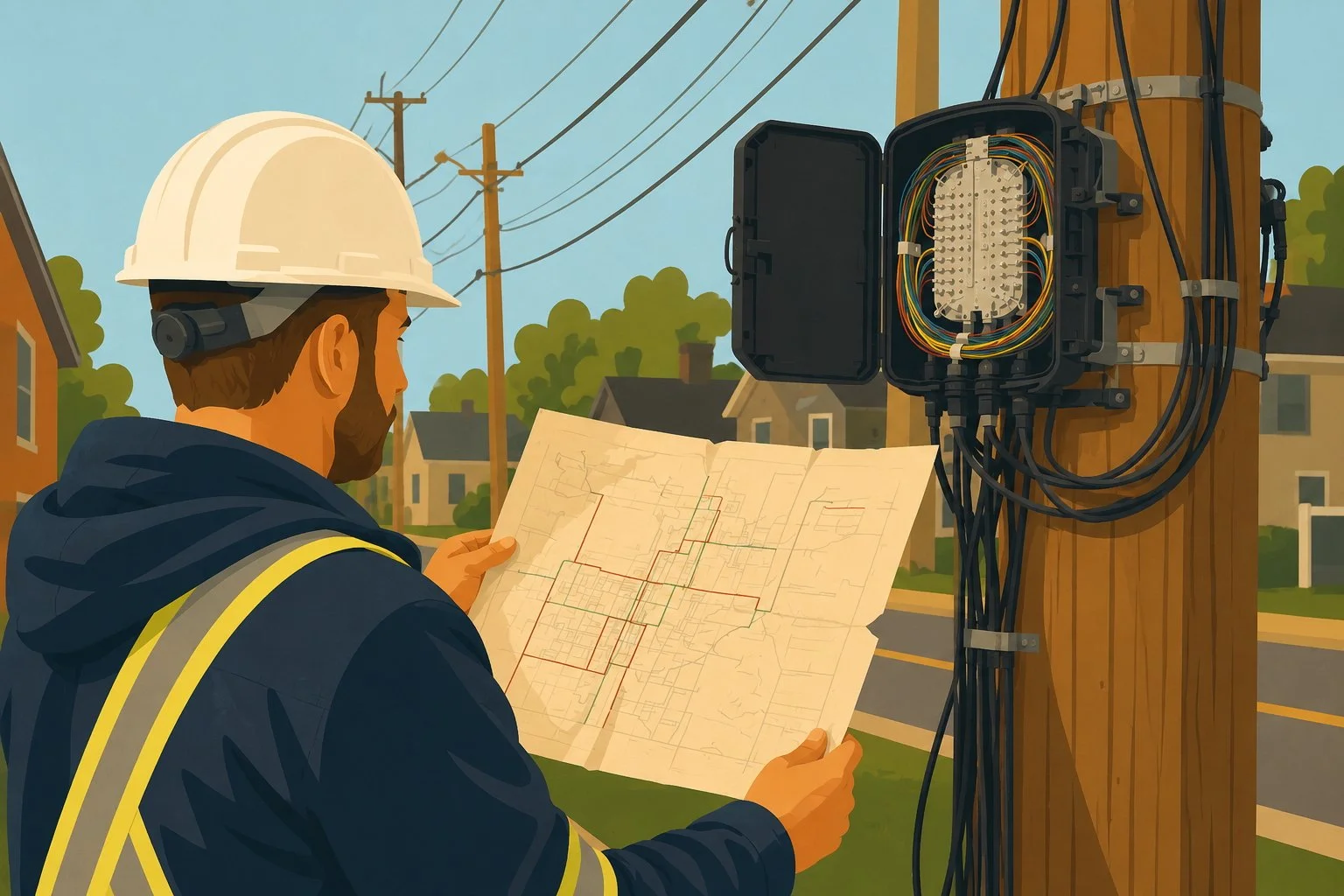
When a fiber optic network is built or upgraded, its documentation is usually accurate. The plans match the ground. Inventories are complete. Connections are known and verified.
Then an intervention is carried out. A cable is moved. A splice is added. A piece of equipment is replaced. A connection is changed.
Taken in isolation, none of these changes seem significant. But accumulated over several months, then several years, they create a problem that every operator eventually knows: the actual network and its documentation gradually stop telling the same story.
A Network Is Never Static
Even after commissioning, a network keeps evolving: new customers to connect, emergency repairs, expansions, service point relocations, redesigns, equipment upgrades. The network lives, changes, and transforms every day.
Yet many organizations still manage their documentation as if it were a snapshot frozen in time, taken once at the moment of construction and rarely touched up since.
A network is alive. Its documentation should be too.
How Gaps Appear
This gap between the field and the systems doesn't necessarily come from poor work by the teams. It builds up through a series of small but very real constraints: the technician is short on time between interventions, information is jotted down by hand on a scrap of paper, photos taken on site stay stored on a personal phone, the official update is postponed until later, and several systems have to be modified manually, one by one.
Each delay, taken individually, seems harmless. But these small gaps add up, and over time, they end up weighing heavily.
The Consequences Show Up Much Later
This is precisely where the problem becomes costly, because its effects don't appear right away.
Capacity search. A fiber is listed as available in the system. In the field, it is already in use.
Intervention. The technician heads out with incomplete or outdated information and loses precious time reconstructing reality on site.
Planning. A new project is designed from data that no longer reflects the actual state of the network, which multiplies the risk of downstream errors.
Troubleshooting. Teams spend a significant part of their time simply validating what is actually in place, before they can even start solving the original problem.
Documentation errors don't always cause an immediate, visible incident. Above all, they create quiet inefficiencies that build up over time, until they become a structural drag on operations.
The Bigger the Network, the Greater the Risk
A small network can often function well thanks to the collective memory of its teams: a few experienced technicians who know the terrain by heart are sometimes enough to make up for imperfect data.
But as soon as the network grows (more assets, more interventions, more technicians, more external partners), that collective memory is no longer enough. Each undocumented change then increases the risk of a gap between the reality on the ground and what is recorded in the systems.
Why After-the-Fact Updates Don't Always Work
Many organizations still follow the same process: a field intervention, notes taken on paper, a return to the office, and then a later update of the systems.
The problem is that anything can happen between the intervention and the update: something forgotten, information lost, a different interpretation of what was actually done, an administrative delay that drags on. And the longer that delay gets, the more the quality of the data deteriorates.
This model worked reasonably well when networks were simpler and teams were smaller. Today, operators need tools that allow data to be updated right when changes are made in the field, with no intermediate step.
To keep the digital twin from falling behind the real network, data must be updated where changes happen: in the field. That continuity between field operations and central systems is precisely what Zonedge was designed to provide.
Keeping a Digital Twin True to the Real Network
The challenge, then, is not just to document a network once. It is to maintain a digital twin that evolves at the same pace as the field, continuously.
A digital twin is only valuable if it faithfully reflects reality. If the data is several weeks or months behind, it gradually stops being an operational tool and becomes a mere historical record, useful for understanding what the network used to be, but less and less reliable for deciding what to do today.
When a network and its documentation tell different stories, every decision gets harder.
In concrete terms, keeping a digital twin accurate requires:
mobile access to data, right in the field;
updates made at the very moment of the intervention;
geotagged photos linked to each asset;
smooth synchronization between field teams and central systems;
a complete history of changes;
a single source of truth, shared across the entire organization.
Zonedge connects the field and the systems in a single ecosystem, rather than treating them as two separate worlds that inevitably end up diverging.
A Concrete Example
Before. A technician replaces a faulty coupler. They take a photo, record the changes on a paper form or in their personal notes, then return to the office. Someone else then has to pick up that information and update the GIS, the inventory, and the related documentation, one system at a time. Between the intervention and that update, several days, sometimes several weeks, can go by.
With Zonedge. The same technician pulls up the asset directly from the field, updates the information on site, adds their photos, and syncs the changes within moments. The information is immediately available to the rest of the organization: planning, engineering, customer service. There is no intermediate step where information can be lost, forgotten, or misinterpreted.
How to Keep the Real Network and Its Digital Twin in Sync
The desired outcome is simple: what your teams see in the systems matches what actually exists in the field, at all times.
Zonedge achieves this through three complementary modules:
Zonedge Terrain lets technicians view data on site, update it immediately after an intervention, add photos, and validate assets without having to wait for a return to the office.
Zonedge GIS centralizes the network inventory, keeps network connectivity up to date, and ensures rigorous tracking of every change.
Zonedge Web gives the entire organization (engineering, operations, planning, management) a clear and consistent view of the real state of the network.
The principle is simple: the closer data is updated to the moment the change occurs, the more reliable it remains over time.
An Issue That Goes Beyond Documentation
It's easy to reduce this problem to an administrative question: keeping records up to date, ticking the right boxes. But data quality is in fact a competitive advantage.
Organizations that can maintain a reliable digital twin make better decisions, deliver their projects faster, and respond to incidents more effectively. Conversely, those that let the gap widen between the field and their systems end up slowing down on all these fronts at once, often without even realizing it, until the cumulative cost becomes hard to ignore.
Reliable Data for a Reliable Network
Fiber optic networks don't only degrade physically. Their data degrades too, silently, intervention after intervention. And when the gap between the field and the documentation becomes too large, every intervention, every project, and every business decision becomes slower, riskier, and more costly.
Maintaining reliable data is not a mere administrative exercise. It is an essential condition for operating a modern network effectively, and that is exactly what Zonedge makes possible, by keeping the network's digital twin as alive as the network itself. Request a demo!
