
Before You Cut a Fiber, Do You Know Who It Will Affect?
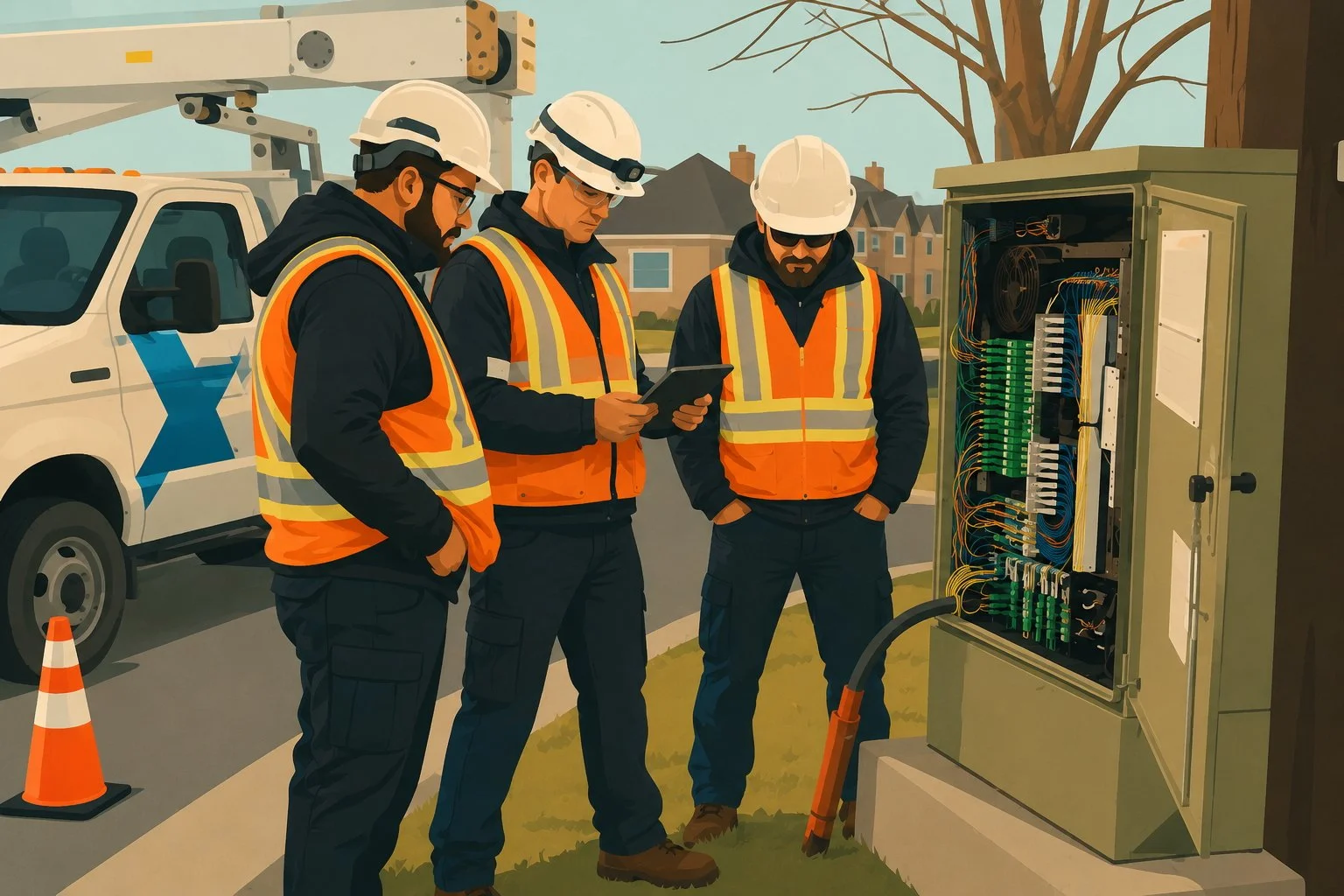
A team needs to replace a piece of equipment, move a fiber, carry out preventive maintenance, or upgrade a section of the network. The intervention is planned. The schedule is set, the technicians are assigned, everything seems under control.
Yet one essential question remains: who will be affected by this work?
In some cases, the answer is simple. In others, it is far more complex, because a fiber optic network is not a collection of independent assets. It is a set of connections where every piece of equipment, every cable, and every fiber can have an impact on several other elements of the network.
To manage such an interconnected network effectively, it is not enough to know where the assets are located. You also need to understand the connectivity that links them and the dependencies that result from it.
Seeing equipment doesn't tell you everything
Two enclosures can look identical. Two fibers can look identical. Two underground vaults can appear to carry the same importance.
Yet one serves a handful of clients, another feeds an entire neighborhood, and a third is a critical link to several downstream pieces of equipment. At first glance, this difference is invisible.
The real value of an asset does not depend only on what it is. It also depends on what is connected to it.
It is this relationship between assets that turns a simple network map into a true model of how the network operates. With Zonedge, operators can represent not only the location of their infrastructure, but also the connectivity that links it together.
In a fiber network, the consequences of an intervention are not always visible to the naked eye.
A substation can affect an entire neighborhood
Picture a city powered by an electrical grid. A substation needs to be taken offline for maintenance.
The challenge isn't just knowing where that substation is located. It's understanding which neighborhoods it powers, which buildings depend on it, and what consequences the work will have for users.
The substation is just one point in the network. Yet its impact reaches far beyond its physical location.
The same principle applies in a fiber optic network. When a fiber, a coupler, or a piece of equipment is involved in an intervention, the impacts can spread across the entire connectivity chain.
The challenge, then, isn't just knowing where you're working. It's understanding everything that depends on that element.
The invisible consequences of an intervention
A team is planning to replace a piece of equipment. Before starting, several questions come up:
Which clients currently use this infrastructure? Which services will be interrupted? Is there redundancy in place? Do certain clients need to be notified? Can the impact be reduced by adjusting the intervention plan?
Without visibility into connectivity, many of these answers remain hard to find. And by the time the consequences surface after work has begun, it's already too late.
The most costly disruptions aren't always the ones that were expected. They're often the ones whose impact was misjudged.
It's precisely at this preparation stage that network visibility becomes a decision-making tool. Before authorizing an intervention, teams need to be able to quickly check the state of the network, track the connections involved, and understand the possible consequences.
With Zonedge, teams have centralized access to network information, letting them consult assets and their connectivity and prepare interventions using up-to-date network data.
Understanding the impact before you act
This is exactly the problem Zonedge is built to solve.
Documented connectivity makes it possible to identify the assets involved, visualize the relationships between equipment, understand which clients depend on a given portion of the network, and analyze potential impacts before work even begins.
Zonedge is designed specifically to give fiber network operators this kind of visibility.
Take an example. A team needs to replace a coupler in a given area. Before the work starts, they need to know which clients will be affected, which equipment depends on that coupler, and whether redundancy is available. Thanks to the connectivity documented in Zonedge, this analysis can be done before the intervention ever begins.
With Zonedge GIS, the network is designed, documented, and maintained in a model that represents not just the assets, but also the relationships and connectivity that tie them together.
With Zonedge Web, this information becomes accessible to the teams who operate and monitor the network day to day. They can consult assets, their connectivity, and the information needed to analyze a situation and plan an intervention.
And when it's time to step onto the field, Zonedge Terrain lets teams access the information they need right at the site and document their interventions as they happen.
The result: the same network information follows the process from planning through to execution, instead of getting lost between multiple tools or multiple teams.
A planned intervention should stay planned
A planned intervention shouldn't reveal major surprises.
And if it does, the problem isn't necessarily the intervention itself. It may simply be a lack of sufficient network visibility.
This happens when connectivity isn't documented, when certain dependencies are unknown, when impacts are assessed manually, or when the information rests on a few key people, the ones who "know the network by heart" until they go on vacation or change jobs.
The best-performing organizations look for answers before work begins. Not during. And certainly not after.
The difference between intervening and intervening with full knowledge
Two teams can carry out the exact same intervention.
The first knows the impacts, understands the dependencies, and knows which clients will be affected. The second discovers the consequences as they go.
The difference isn't in the skill of the technicians. It's in the quality of the information available before the intervention.
And that is precisely where network management becomes an operational advantage.
Conclusion
A planned intervention should be predictable. To achieve that, it isn't enough to know where the assets are located: you need to understand the relationships that connect them.
Before cutting a fiber, replacing a piece of equipment, or modifying a section of the network, teams need to be able to quickly identify the potential impacts on clients, services, and infrastructure.
This is exactly what Zonedge exists for: to give operators a complete solution for designing, operating, and evolving their fiber optic networks from a single, shared understanding of the network.
With its connectivity management, network mapping, and tools for both the office and the field, Zonedge makes it possible to plan interventions with a clear view of their consequences.
Because a good intervention doesn't begin when the work starts.
It begins when the network is fully understood.
And when an intervention is truly planned, it should never become a surprise.
Request a demo!
