
Speed skating: When every millisecond counts in your network
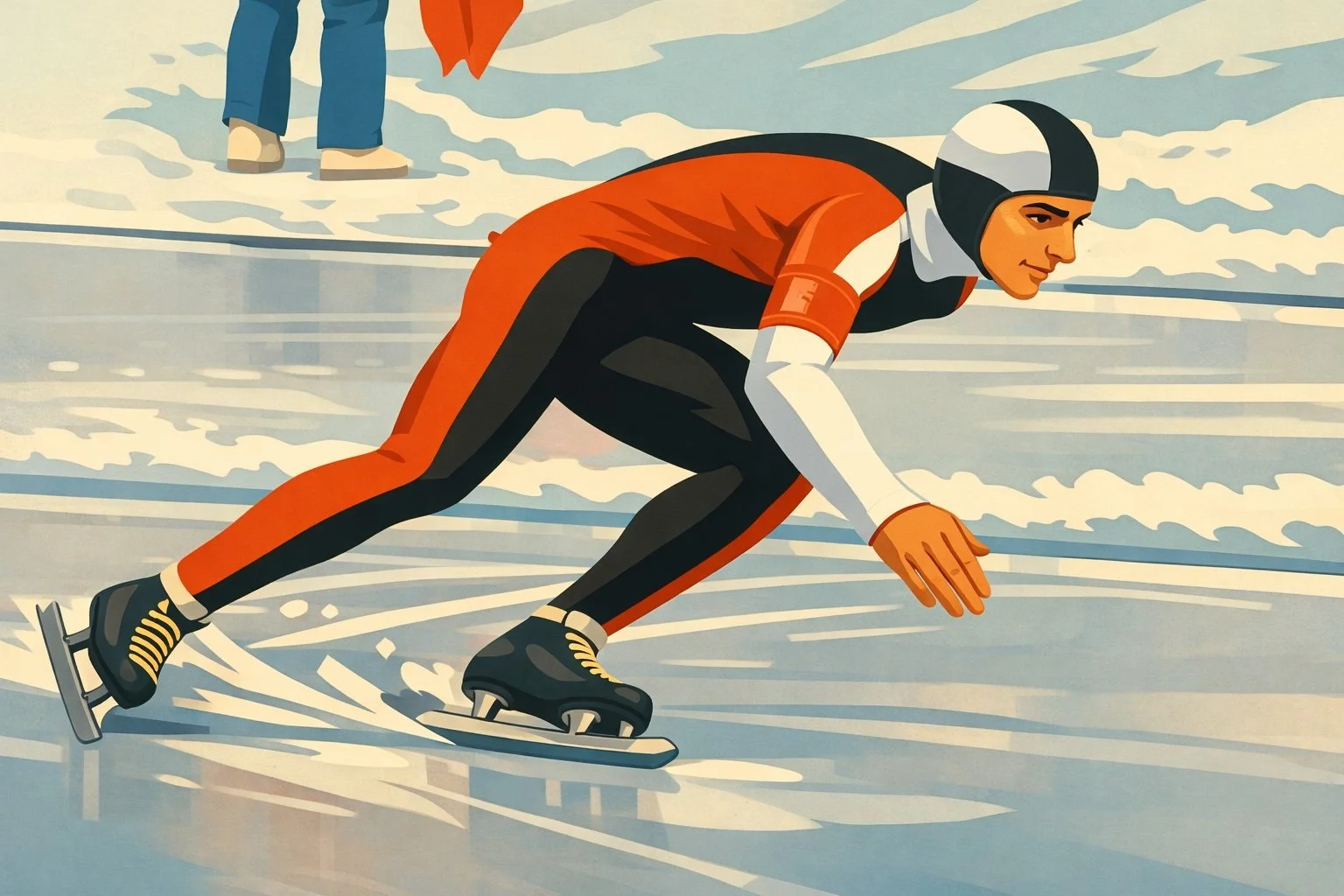
Have you ever watched a speed skating race at the Olympics? Those athletes hurtling across the ice at over 60 km/h, shaving millimeters off the curves, where a fraction of a second makes all the difference between gold and fourth place? Well, that's exactly what's happening in your fiber optic network every second. Except for you, it's not a medal that's at stake; it's your customers' satisfaction and the reputation of your service.
In speed skating, it's all about pure performance. No frills, no artistic flourishes, just the fastest possible race from point A to point B. For your fiber optic network, it's the same thing: your data must travel as quickly as possible, with as little friction as possible, and you must be able to track every millisecond of its journey.
The starting line: Know your ice field
Before a speed skater puts their blades on the ice, they know every inch of the track. They know where the ice is fastest, where it is roughest, and exactly how to optimize their route to shave off those precious fractions of a second.
With Zonedge, it's the same for your network. You need to know your infrastructure down to the smallest detail: every fiber segment, every splice, every connector, and above all, the condition of each of these elements. Because a poorly cleaned connector or a splice that generates too much loss is like a skater dragging a five-pound weight around their ankle. It slows everything down, and in a race where milliseconds count, that's unacceptable.
The Zonedge GIS mapping environment allows you to visualize your network with surgical precision. You can trace the exact path of a fiber, see its position in the cable, know the distance between each splice point, and identify optical losses at each stage. It's your roadmap, your guide to optimizing performance.
Tight turns: Plotting and optimizing the route
In a speed skating race, turns are crucial. That's where you win or lose the race. Take a turn too wide, and you lose precious seconds. Take a turn too tight without the proper technique, and you risk losing your balance or slowing down dangerously.
In your network, your "turns" are your splices, connectors, and optical splitters, all those points where the signal must pass from one segment to another. Each transition generates losses, however minimal. And these losses add up. A splice that generates 0.1 dB of excess loss may be nothing individually. But multiply that by 20 splices on a path, and suddenly you have 2 dB of excess loss; enough to make the difference between a service that works perfectly and one that fails.
With Zonedge, you can trace fiber end-to-end and analyze exactly where losses are occurring. The tracing tool shows you every segment, every splice point, every distance. You can even integrate your OTDR measurements directly into the system and locate an anomaly at the precise location of a break or excessive loss. It's like having a coach who analyzes each of your turns frame by frame to tell you exactly where you can save time.
The relentless stopwatch: Detecting slowdowns in real time
On the Olympic ice rink, the clock never lies. It displays every millisecond, without mercy. A skater who starts to slow down sees it immediately on the giant screen. And that's exactly what you need for your network: a system that tells you in real time when something isn't working right.
This is where Zonedge's collaborative environment becomes your best ally. Imagine that a customer complains about a drop in performance on their connection. With traditional tools, you start searching: maybe in an Excel file here, an AutoCAD plan there, a few notes scribbled on a piece of paper after a field intervention last week... Meanwhile, the clock is ticking, and your customer is waiting.
With Zonedge Web, anyone in your organization can instantly access information. Your on-call technician, even at 3 a.m. on a Sunday, can log in from their phone and diagnose an OTDR distance directly in their browser. They can see the entire fiber path, identify where the problem is located, and even check if recent work has been documented in that area thanks to real-time field observations recorded by your teams.
That's the difference between a 15-minute response time and a 3-hour response time. In the world of modern telecommunications, where your customers expect impeccable service 24/7, those 3 hours can mean the difference between keeping a customer or losing them.
Invisible training: The preparation that makes all the difference
Do you know what separates an Olympic medalist from a good skater? It's the thousands of hours of training that we don't see. Video analysis of every race, constant adjustments to technique, optimization of equipment down to the tenth of a millimeter.
The same applies to your network. True performance is built before a problem even arises. It lies in the careful planning of your deployments, in the comprehensive documentation of each element, and in preventive maintenance that identifies problems before they become critical.
Zonedge GIS gives you the tools you need to prepare. You can see at a glance where your fiber is available, identify the best routes for a new deployment, and validate the feasibility of a project before even mobilizing a team. This helps you avoid unpleasant surprises such as "we sent three technicians to dig for two days only to realize that we already had a conduit available right next door." The design tool allows you to plan intelligently, optimize your routes, and choose the approach that will save you time and money.
And when your teams are in the field with Zonedge Terrain, they document everything in real time: photos of splices, notes on installation conditions, precise geolocation of equipment. This information is immediately available in the system, even if your technician is working in an area without cellular coverage, thanks to offline mode. As soon as they reconnect to the network, everything syncs automatically.
Recovery after a fall: React quickly when things go wrong
Even the best skater can stumble. A blade catches for a moment, a momentary loss of balance, and down they go. But what separates a champion from an amateur is the ability to get back up instantly and minimize the damage.
In your network, "outages" refer to failures, fiber breaks, and faulty equipment. These things happen. A backhoe cutting a cable, a storm tearing down wires, a curious rodent chewing through a protective sheath... You can't always prevent these incidents, but you can control your response time.
With Zonedge, locating a fault is as simple as searching for an address on Google Maps. Your technician enters the measured OTDR distance, and the tool shows them exactly where the problem is located in the field. No more need to walk miles of cable hoping to find the right segment. You go straight to the right place, with the right tools, and make the repair.
And because all your documentation is centralized and up to date, you know immediately which customers are affected, what the network configuration is at that location, and how to route traffic while waiting for repairs. It's like having a plan B ready before the problem even arises.
The podium: When performance becomes a competitive advantage
Ultimately, why do all these skaters train like madmen to shave off a few milliseconds? Because in their sport, that's what makes the difference between stepping onto the podium and going home empty-handed.
For you, it's the same thing. In a market where all operators promise ultra-fast fiber, what sets you apart is your ability to consistently deliver on that promise. It's your response time when a problem arises. It's the reliability of your service, day after day, month after month.
Zonedge gives you the tools to be that performance champion. Not because the software is magic, but because it allows you to work smarter. Your teams spend less time searching for information and more time solving problems. Your planning is more accurate because you have all the data you need at your fingertips. Your responses are faster because you know exactly where to go and what to do.
The finish line: A network that performs, a customer that stays
In speed skating, the race ends when the skater crosses the finish line. But for your network, there is no real finish line. It's a race that continues day after day, where every millisecond counts, where every failure avoided or quickly resolved contributes to building your reputation.
The skaters who will be racing on the ice at Milan-Cortina 2026 have spent years optimizing every aspect of their performance. They have analyzed every turn, timed every segment of the track, and adjusted their equipment down to the millimeter. They know that in their sport, it is the accumulation of all these small gains that makes the difference between stepping onto the podium and going home empty-handed.
With Zonedge, you have everything you need to manage this never-ending race. Detailed network inventory, tracing and diagnostic tools, real-time access to information, seamless collaboration between your teams, everything is in place to ensure your network performs to its full potential.
Because at the end of the day, it's not just about technology or fiber optics. It's about serving your customers. And in a world where everyone expects everything to work instantly, having the right tools to optimize every millisecond of your network isn't a luxury. It's a necessity.
So, are you ready to lace up your skates and turn your network into a performance champion?