
“You are here”, But do you really know where your fibers are?
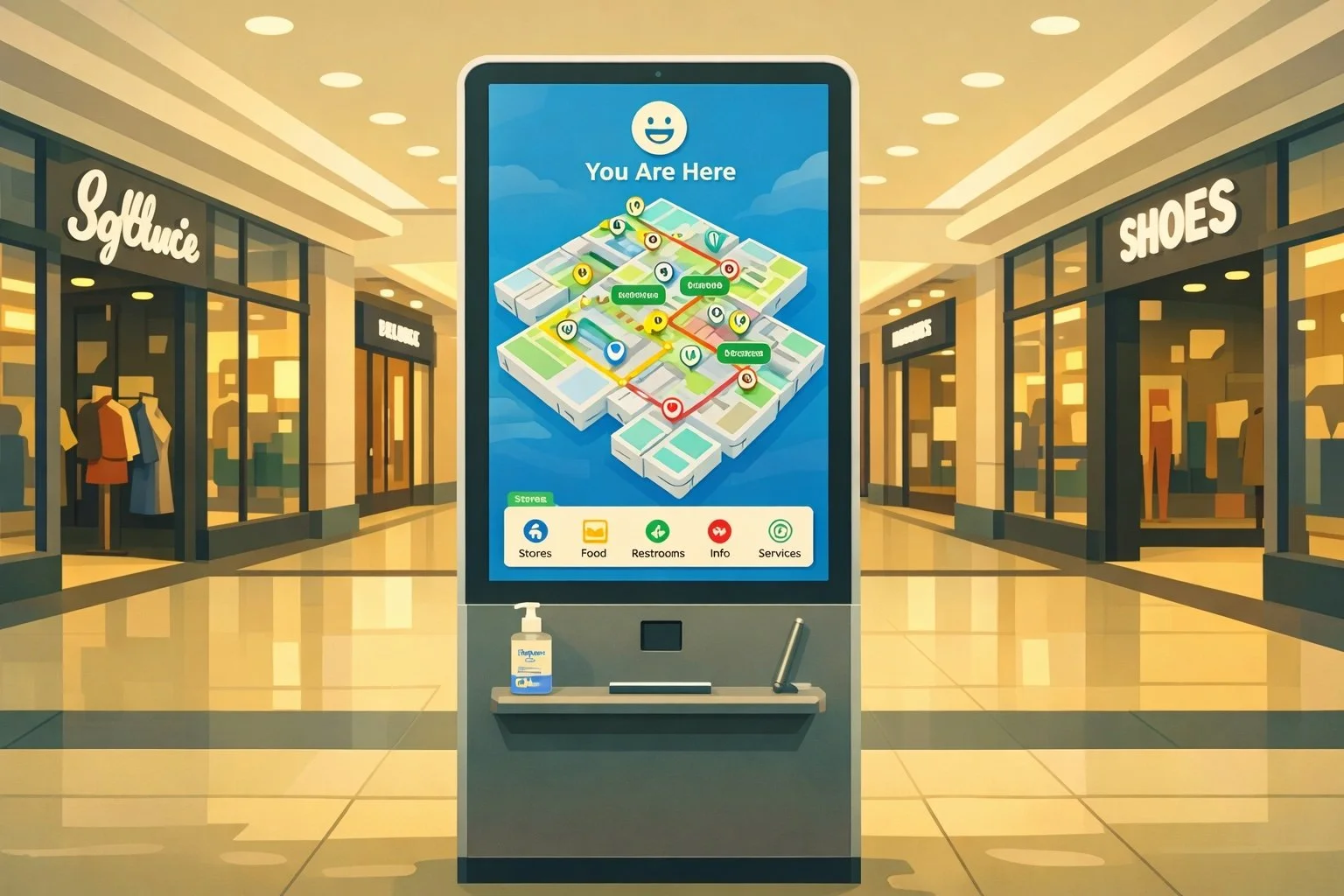
You know that big directory board in the mall, the one with the floor plans, the little store logos, and that red (or yellow, depending on the mall) star with the words “You are here”?
If you’ve ever looked for a pharmacy in a three-story shopping complex with 140 stores, you know just how much that little sign can save you an entire afternoon. Without it, you end up going in circles. You walk past the same phone booth twice. You eventually end up asking a janitor.
Now imagine that same feeling of confusion, but multiplied by one thousand, when you try to trace a fiber in a network that stretches tens of kilometers through streets, fields, buildings, and underground infrastructure.
This is exactly the daily challenge faced by teams managing fiber-optic networks without the right tools. And this is exactly where Zonedge makes a difference.
A shopping mall is simple. A fiber-optic network is much less so.
In a typical shopping mall, there are usually a few hundred stores spread across several floors. The "You Are Here" sign is all you need. You can find your destination in thirty seconds.
In a municipal or regional fiber-optic network, there are thousands of individual fibers, hundreds of connection points, splices, distribution panels, poles, and underground conduits, all spread out over miles of territory, sometimes in dense urban areas, sometimes in the open countryside.
And unlike stores in a shopping mall, the fibers aren’t on display. They’re buried. Hidden. Silent. Until the moment they’re no longer silent, because there’s an outage, or because a customer calls to report that their service has gone down.
That’s when you realize just how essential it is to have a “You Are Here” feature for your network. It’s not a luxury, it’s an operational necessity.
Your digital twin: your network's control panel
That's where the concept of a digital twin comes in, and it's at the heart of what Zonedge offers you.
A digital twin is a comprehensive, interconnected virtual representation of your physical infrastructure. It’s not just a map. It’s not just a list of assets in a spreadsheet. It’s a true digital mirror of your network, in which every fiber, every connector, every support structure, and every connected customer exists and is linked to the others.
Just like the sign at the shopping center, your digital twin tells you where you are. But it also tells you: where your customer is, where the likely outage is, and which path the signal takes from the central office to the subscriber at the end of the street.
And best of all, it tells you all this in just a few clicks, not after hours of searching through paper files or scattered Excel spreadsheets.
Tracing a fiber's path: from the central office to the end user
Think about the shopping mall again. When you’re looking for the pharmacy, the sign doesn’t just show you a red dot. It shows you the entire route: stairs, main corridor, turn right after the café.
In Zonedge, that’s exactly what end-to-end traceability does. You select a customer, an address, or a piece of equipment, and the system automatically traces the entire path of the fiber: which distribution panel it originates from, which cable it runs through, which splices it passes through, and which final outlet it connects to.
This traceability is what prevents your technicians from spending an hour in the field trying to figure out where the problem lies. It’s what allows your customer service team to give a concrete answer when someone calls: “Yes, ma’am, we can see that your connection runs through the panel on Maple Street, we’ll have a technician in the area in fifteen minutes.”
That is the difference between an organization that responds with confidence and one that responds in a panic.
Troubleshooting a power outage: seeing the light at the end of the tunnel
In a shopping mall, if the escalator is out of order, it’s obvious. Someone puts up an orange cone, and you take the stairs instead.
In a fiber-optic network, a fault is often invisible to the naked eye. The break might be 3 kilometers from here, buried 60 centimeters under asphalt, in a conduit shared with other cables. Without a digital twin, pinpointing the exact location is like detective work, and requires a good dose of luck.
With Zonedge, all your network data is integrated into a single system. When an alarm is triggered or a signal drops out, you can immediately cross-reference the information: which customers are affected, which section is involved, and which technician is closest to the area. You arrive on-site with a clear objective, not a question.
And this holds true for both local fiber connections and major transport links, because Zonedge manages the entire network architecture, from the core of the network all the way to the last meter at the subscriber’s premises.
Everything is connected, and that’s exactly what makes it so powerful
Let’s go back to the shopping mall for a moment. What makes the “You Are Here” sign truly useful isn’t just the red dot. It’s the fact that all the information is right there, in one place, connected and consistent. The stores, the exits, the staircases, the restrooms, the parking lots.
That’s exactly the philosophy behind Zonedge’s digital twin: everything is in a single environment, and everything is interconnected.
Zonedge GIS gives you a geospatial map view of your network, every piece of infrastructure, every route, and every asset precisely located on the ground. It’s your shopping center map, but in the real world.
Zonedge WEB gives you access to this same data via a web browser, in real time, from anywhere. Your technical director in a meeting in Montreal can see exactly what your field technician in Rivière-du-Loup is seeing. Same information, at the same time.
Zonedge TERRAIN is the tool for your field teams, data collection, inspections, asset updates, that feeds real-time data into the digital twin. Whatever the technician observes on the pole or in the pull chamber is instantly reflected in the central system.
The result? Your "You are here" feature never becomes outdated. It reflects the actual network layout at all times.
A single source of truth for the entire organization
In companies that manage their networks the old-fashioned way, we often see the same thing: every department has its own version of the truth. Engineering has its AutoCAD drawings. Operations has its Excel spreadsheets. Customer service has its ticketing software. And nobody really talks to anyone else.
The result is that when a problem arises, the first half-hour is spent gathering information, calling the right people, and finding the right file.
With a centralized digital twin like Zonedge, there’s only one screen in the shopping center. And everyone looks at it at the same time.
Engineers plan network expansions based on real-time field data. Technicians head out on calls equipped with accurate maps and full traceability. Management has dashboards that reflect the actual state of the infrastructure, not a summary of three conflicting reports.
That’s the single source of truth. And in an industry where decisions are made quickly and mistakes are costly, that’s no small matter.
So, do you know where your fibers are?
If the honest answer is “more or less” or “it depends on who you ask,” then you might need your own “You Are Here” sign.
Not just to find a pharmacy. To track your customers, anticipate service disruptions, coordinate your teams, and make decisions based on facts, not assumptions.
Zonedge is the all-in-one digital twin that transforms the complexity of your fiber-optic network into something you can see, understand, and control. A clear map. Complete traceability. A team that always knows where it’s going.
Because if you get lost in a shopping mall, all you have to do is ask a janitor.
Getting lost in your own fiber network is a whole different story.
Curious to see what your digital twin looks like? Request a demo here.