
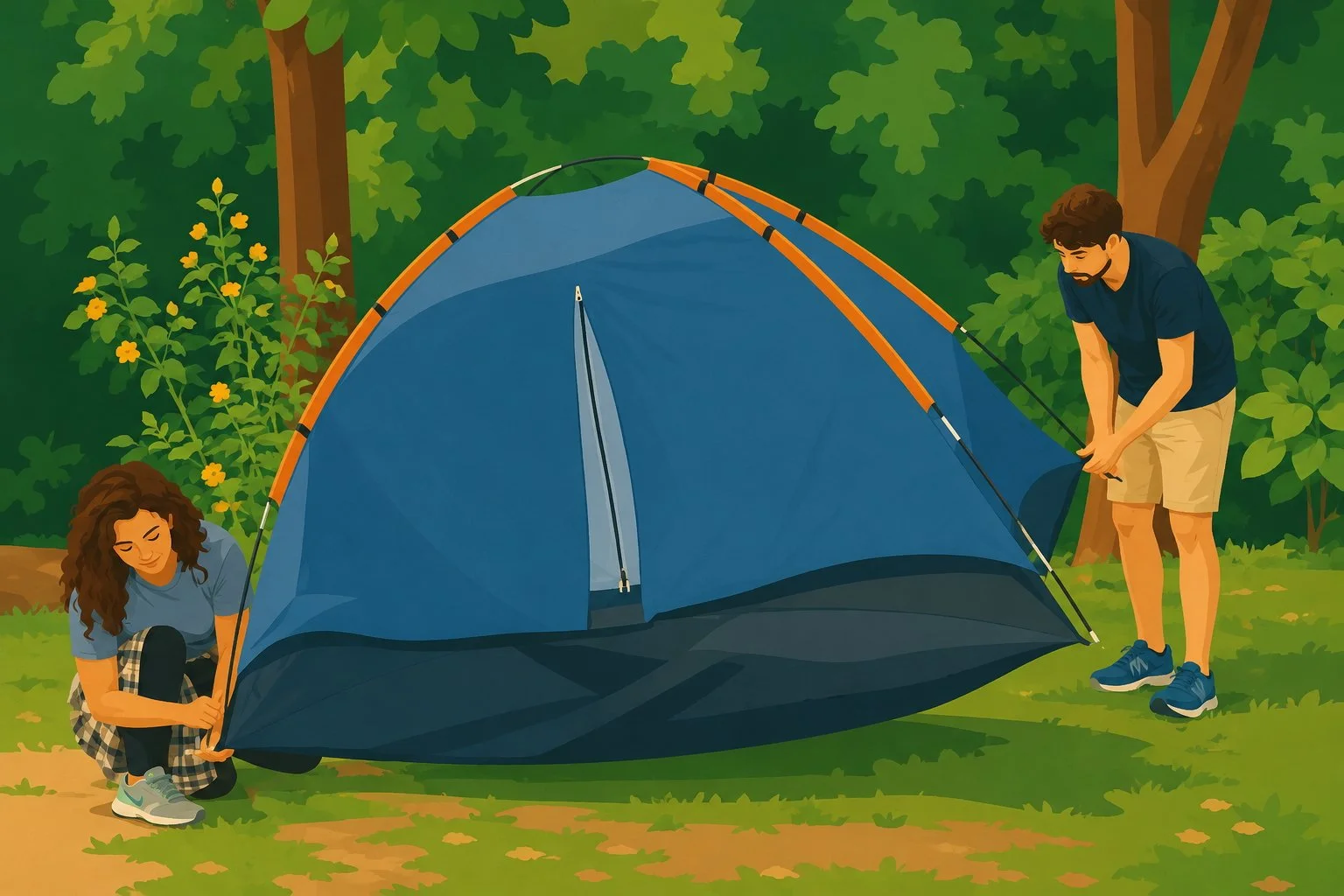
Have you ever arrived at a campground on a Friday night, after a two-hour drive, only to realize you forgot the corkscrew? Or the flashlight? Or, the classic, the tent stakes?
All things considered, it's not the end of the world. You improvise, you figure it out, you borrow from your neighbor's site. But when you're managing a fiber network, if you're missing a critical piece of information at 11 p.m. on a Sunday, you don't have a neighbor to turn to.
Forgotten equipment means your network data is incomplete
Any experienced camper will tell you the same thing: you should make your gear list before you leave, not in the park’s parking lot. Because once you’re there, if something’s missing, it’s missing. There’s no Canadian Tire in Ayers Cliff at 10 p.m.
The reality for fiber operators is often the same. The network data is there, at least in part. A cable is documented in an Excel spreadsheet, a splice is noted in a PDF somewhere on a server, and a technician remembers a change made last year that he didn’t have time to log. All of this together looks like an equipment list with gaps in it.
When an outage occurs, that's when the gap becomes a problem. You're looking for a piece of information that should take thirty seconds to find. It ends up taking forty-five minutes. Meanwhile, subscribers are without service.
With the Zonedge platform, network documentation isn’t scattered across files, notepads, and notebooks. Each component is geolocated, linked to its attributes, and visible to the team both in the office and in the field. When a technician completes a job, they update the information directly from the job site. The office team sees the change. The map reflects what’s actually on the ground. It’s not just a pretty map; it’s a complete inventory of equipment, kept up to date as work progresses, not reconstructed after the fact.
Set up camp before nightfall
Ask anyone who's been camping for a long time: you don't make important decisions after dark. Where to pitch your tent, how to set up camp, where to put your cooking area, all that should be figured out during the day, while you can still see what you're doing.
An experienced camper doesn't choose a campsite upon arriving at 9 p.m. with a headlamp. He looks at the park map in advance. He knows which site he's going to. He's figured out where the water will run off if it rains during the night. Because planning ahead when everything is going well is what keeps you from panicking when things don't go as planned.
The principle applies word for word to network management.
When an emergency strikes, whether it’s an excavator that’s cut a cable or an ice storm that’s knocked a node offline, it’s too late to start looking for your plans. The outage won’t wait for you to find the right file. And your customers certainly won’t either.
The operators that fare best in these situations aren't necessarily the most experienced ones. They are the ones whose documentation is already in order before the crisis strikes. They know, even before heading out into the field, which cable is affected, how many subscribers are impacted, and where to start.
Zonedge gives you that edge. Your network plan is created in advance, updated as needed, and accessible whenever you need it, whether you're at the office or in the truck, on your way to a breakdown. No need to call someone to find out what to do. The information is right there on the screen, even before you arrive at the scene.
Knowing where everything is
A good camper doesn't spend ten minutes rummaging through the trunk looking for the can opener. He knows where it is. Because he has a system.
The first-aid kit is always in the same bag. The camping stove is always in the same box. The spare rope is tied next to the tent. When everyone knows where everything is, the camping trip goes smoothly. When nothing is in its place, the first five hours are spent getting organized instead of enjoying ourselves.
What makes things complicated at the campsite is when several people are getting ready together. Everyone has put their things in the trunk. No one saw what the others put in. The result: three bottle openers, zero can openers. The problem isn't a lack of equipment; it's a lack of coordination.
For a fiber-optic network operated by a team, it’s exactly the same dynamic. Alex documents his work in his own way. Sophie uses a different format. Simon, on the other hand, jots everything down in a notebook that only he can understand. Everyone knows what they’ve done. No one really knows what the others have done. And when Alex is on vacation and someone has to take over his sector, it turns into a treasure hunt.
A well-maintained network inventory in Zonedge is like a camping supply box organized by someone who’s done this a hundred times. Every item has a designated place. Every update made by a technician in the field is automatically synced to the platform. No matter who opens the file the next morning, David, Caroline, or a new team member, the information is there, structured and up to date. When someone needs information, they have it. No questions asked, no searching, no delays.
And that makes a difference in the long run. A well-documented network is one that can be expanded intelligently. You can add capacity in the right places. Plan expansions without having to start from scratch. Respond to a municipal request for proposals with reliable data, not rough estimates based on memory.
Camping and network management have more in common than you might think. In both cases, what makes the difference between an enjoyable experience and a nightmare night is what you did before you left: your gear, your plan, and your organization.
It's the same with fiber optics. You don't want to find out what was missing from your documentation only when a failure occurs. And unlike when you're camping, there's no night to rest and recharge; the network never sleeps.
Zonedge is designed for teams that want to stop rummaging through their trunks and start operating with a real plan. Request a demo!
